


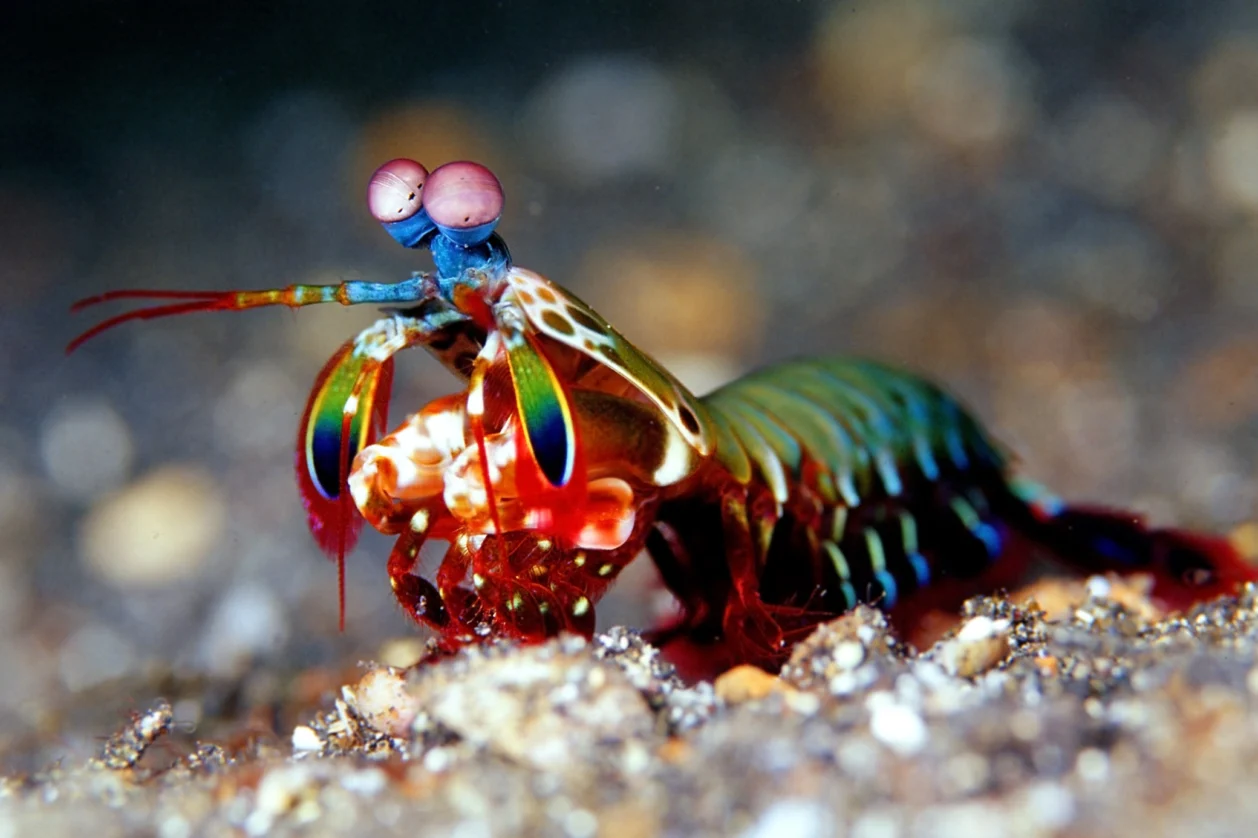
I cannot forget the first time I watched the documentary of a mantis shrimp. I believed it to be a myth. It is this interest that prompted me to go as far as purchasing a book on marine biology at one of those online stores that deal on aquatic life. Ever since, I have been interested in these little and yet powerful underwater boxers.
My Journey into the World of the Mantis Shrimp
I came across the mantis shrimp first as I was browsing one of the nature photography boards. One of the accounts had shared a breathtaking close up shot of a rainbow-colored animal with alien-looking eyes, and a fierce caption: “The fastest punch in the ocean.” I was immediately addicted. Within minutes I had placed an order of marine biology starter kit with a well-established on-line pet aquatic shop.
The kit included an elaborate explanation of how marine crustaceans work, the section on mantis shrimp was the most interesting. I would discover its punch has a speed of 50 mph and a force equal to a. 22 caliber bullet which addressed my overriding question: Is a mantis shrimp punch faster than a bullet? Almost! It is still faster in regard to pure speed but the acceleration of the shrimp strike cannot be found in the animal kingdom.
Interestingly, my research led me to TechBuzzer’s fascinating guide on striking power in humans, which made me realize how far we are from matching this ocean marvel’s capabilities.
Understanding the Science Behind the Strike
The claw of the mantis shrimp is a dactyl club that is constructed in the form of a biological hammer. It contains a saddle-shaped structure having elastic energy inside its limb when cocked back. When the club is released, we achieve an acceleration of 10,000 g which forms a cavitation bubble, a small burst underwater that gives the prey a second shockwave.
That is why the response to the question Can a mantis shrimp punch as hot as the sun? is technically affirmative in the micro-scale vibe. The temperature of the collapsing cavitation bubble briefly reaches levels as high as the surface temperature of the sun.
As a matter of fact, scientists at Harvard invented a robot based on this mechanism, showing that it is not all brute force but high biomechanics. Consequently, the mantis shrimp can be termed as the fastest striking animal in the world.
For tech lovers, you’d appreciate that the mechanics behind this are similar to high-tension systems in engineering. Just like a perfectly designed spring-loaded device, the mantis shrimp’s claw stores and releases energy with incredible precision. TechBuzzer’s engineering insights offer similar examples in human-made tools.
My Close Encounter at the Aquarium
Several months following my research, I visited a free aquarium, where one of the mantis shrimps was placed in a strengthened glass tank. The guide cautioned us against tapping the glass not because it puts strain on the creature but because these animals can break through the glass aquarium with its strike.
Watching it at work was a surreal feeling. The shrimp hit the shell of a crab so fast and the next thing I could see was the shell of the crab cracked wide open. This brought up my question as to whether mantis shrimp punches are painful or not, in case the strike fell on human skin it would hurt badly or even fracture a finger.
It reminded me of predator-prey relationships in the ocean and the Chinese https://en.wikipedia.org/wiki/Mantis_shrimp has one of the fastest creatures to secure its food even before the prey gets to know what just hit him.
Pros and Cons of This Natural Weapon
Although the punch of the mantis shrimp is impressive, there are positive and negative aspects of it biologically.
Pros:
- Rate of Acceleration unparalleled and anything faster than it has never been recorded in nature.
- Twofold Damage: The first attack and the cavitation bubble also damage the prey.
- Predator advantage: It can kill the prey with a hard shell easily.
- Hardware: The weapon is a club that comprises a blend of materials that are tough enough as compared to ceramics manufactured by humans.
Cons:
- Energy Cost: A lot of energy is needed to load the punch.
- Small Range: It is only devastating with a short distance range.
- Danger of being damaged: Abuse or hitting against unmovable things can damage the shrimp itself.
It’s a reminder that even the best-designed systems whether natural or human-made come with trade-offs, something TechBuzzer often explores in product reviews.
Why This Fascination Matters Beyond Marine Biology
You may ask what could an outsider to the marine biology field possibly have a reason to be concerned with how fast a mantis shrimp can punch? Well, humanity draws its inventions on the forms created by nature. Robotic arms, aerospace mechanisms, and many others can be based on the studies of this animal strike to work faster and more efficiently.
In the case of athletes, it is a lesson on how to train explosive power. In the case of tech innovators, there is efficiency of energy transfer. And those of a curious mind will have a reminder that the ocean is so much more than what appears at the surface.
If you’re interested in how humans can improve their own striking techniques, check out TechBuzzer’s punching tips though spoiler alert: you won’t outpunch a mantis shrimp.
Final Thoughts
Shrimp mantis punch is a master seminar to the engineering of nature by trying to combine speed, power, and precision in a manner not done by another animal. It is more than just marine trivia, it is inspiration of science, tech and simply human wonder.
FAQs
Q1: Does the punch of a mantis shrimp outspeed a bullet?
Not in speed, raw speed, but in acceleration, yes. The strike of a mantis shrimp breaks the record as it receives 50mph at an acceleration rate of 10,000 g making it the strongest in the animal kingdom.
Q2: Does mantis shrimp punch hurt?
Extremely. The direct impact of shells can break glass (or even fingers), so it can be very hazardous to manipulate directly.
Q3: Does a mantis shrimp have enough punch to be hot like the sun?
The shrinking cavitation bubble briefly attains sun-hot temperatures, in microscopic size.